
People taking semaglutide for weight management lose about 6% of body weight by month 3 and 11% by month 6, based on a real-world study of 175 patients. On Ozempic's own maximum 2mg dose, the diabetes trial that tested it recorded an average loss of 6.9kg over 40 weeks. Those numbers assume you stay on the medication and don't include the plateau that typically hits around month 12-18, or the weight regain that follows if you stop taking it.
- Semaglutide averages about 6% weight loss by month 3 and 11% by month 6. People with type 2 diabetes lose less: 7.2% at month 6, against 11.8% for people without it.
- Ozempic is FDA-approved for type 2 diabetes; Wegovy uses the same drug at a higher dose specifically for weight loss.
- Weight loss on Ozempic plateaus around month 12-18 without changes to diet or activity.
- A GLP-1 weight loss calculator projects week-by-week loss using your starting weight and dose schedule.
Why this matters
Ozempic wasn't built as a weight loss drug. It's approved for type 2 diabetes, and any weight loss result you've seen online is coming from off-label use or from trials of the same molecule (semaglutide) at different doses. Wegovy is the version actually approved for weight management, and it tops out at a higher dose than Ozempic's 2mg ceiling.
That distinction matters because the numbers people quote for "Ozempic weight loss" often come from Wegovy trials, which inflate expectations. If your doctor has you on Ozempic specifically, your realistic ceiling is closer to the lower end of the range.
How much weight do you lose on Ozempic?
Here's the breakdown by treatment duration, based on clinical trial data for the 2mg maintenance dose:
| Timeline | Average weight loss | What's happening |
|---|---|---|
| Month 1 | 1-2% | Dose titration, appetite suppression starts |
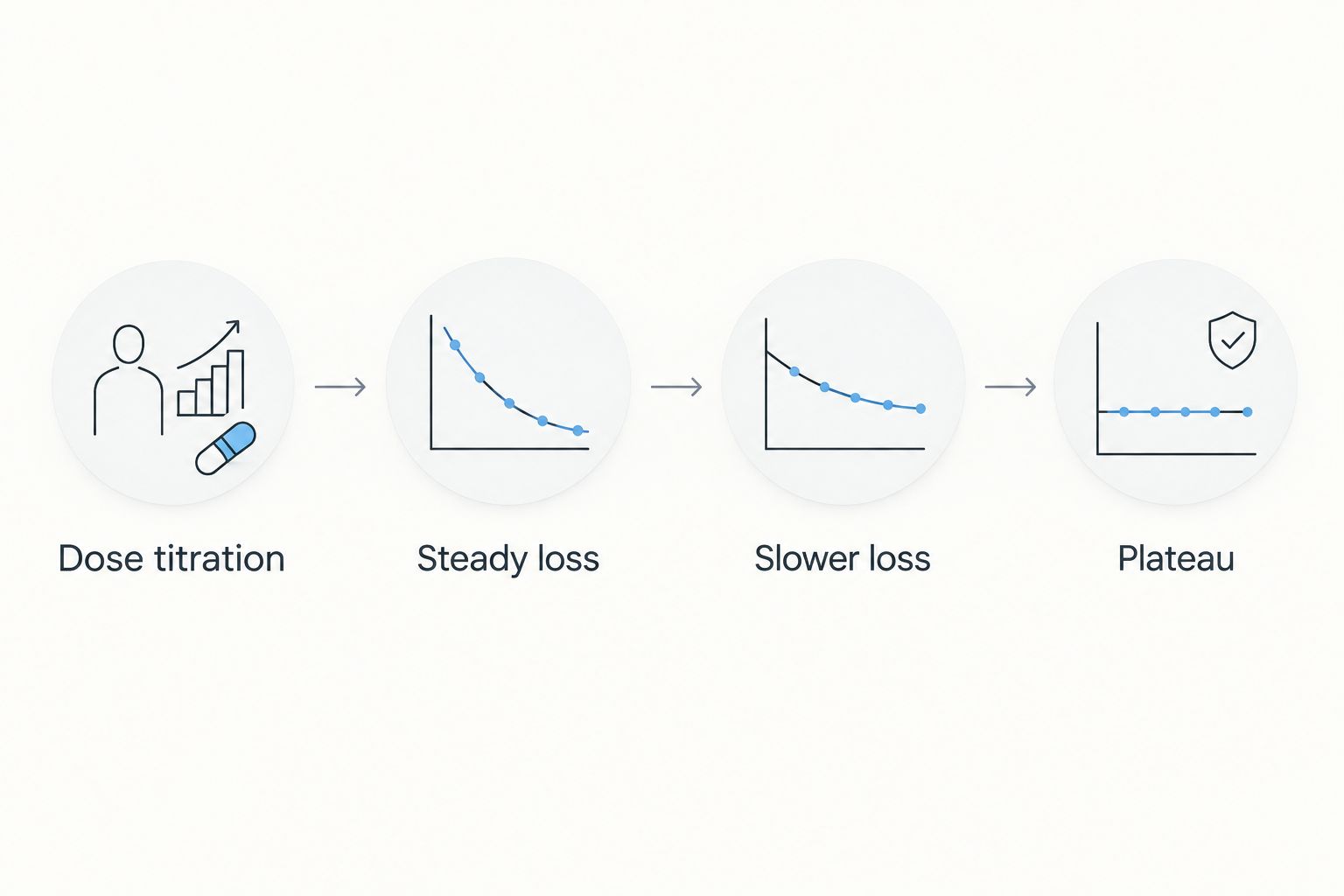
| Month 3 | ~6% | Steady loss as dose reaches maintenance level |
| Month 6 | ~11% | Continued loss, slower rate than months 1-3 |
| Month 12 | 6.9kg on 2mg at 40 weeks | The 12-15% figures often quoted come from Wegovy's 2.4mg trials, not Ozempic |
| Month 18+ | Plateau | Loss stalls without added lifestyle changes |
The rate of loss isn't linear. You lose the most weight, proportionally, in the first three months, then the curve flattens even though you're still taking the same dose.
Month 3: about 6% body weight loss
By the three-month mark, most people taking semaglutide for weight loss have lost around 6% of starting body weight, or about 3.9% for people with type 2 diabetes. This is the point where the dose has usually reached its maintenance level after gradual titration from the starting 0.25mg dose.
Appetite reduction is strongest in these early months, which is why the rate of loss is fastest here compared to any later stretch of treatment.
Month 6: about 11% body weight loss
At six months, average loss sits around 11% of starting body weight for people who stayed on the medication continuously, split as 11.8% for people without type 2 diabetes and 7.2% for people with it. The pace slows compared to the first quarter, but it's still meaningful, and it's the point where most clinicians reassess whether the current dose is working.
If you're under 5% loss at month 6, that sits below both the trial and the real-world averages, and it is worth raising with your prescriber.
Month 12: what the trials actually show
There is no trial of Ozempic's 2mg dose that runs a full year in people without diabetes, so any precise 12-month figure for Ozempic is an estimate. What the trials do show: 6.9kg over 40 weeks on 2mg in people with type 2 diabetes (SUSTAIN FORTE), and 9.6% over 68 weeks on the higher 2.4mg dose in people with type 2 diabetes (STEP 2). The 14.9% figure that circulates as "Ozempic results" is STEP 1, which tested 2.4mg in people without diabetes. That is the Wegovy dose, not Ozempic's. Loss also flattens toward the end of the first year as the body adapts to the appetite-suppressing effect.
Some people keep losing slowly past month 12, but the rate drops off sharply compared to the first six months.
Why Ozempic results vary so much
No two people lose weight at the same rate on the same dose. The spread between someone losing 5% and someone losing 20% comes down to a handful of factors:
- Starting weight and BMI — higher starting weight often correlates with larger absolute pounds lost, even at similar percentages
- Dose reached — people who tolerate and reach the full 2mg maintenance dose lose more than those capped at 1mg or lower due to side effects
- Diet and activity changes — Ozempic suppresses appetite, but it doesn't force behavior change; pairing it with a calorie deficit accelerates results
- Consistency — missed doses or gaps in treatment slow or reverse progress
- Individual metabolic response — some people are simply more responsive to GLP-1 medications than others, and clinical trials show a wide distribution around the average
- Length of time on the medication — loss is front-loaded in months 1-6, so someone three months in will look very different from someone at month 12
“The fastest weight loss on Ozempic happens in the first three months — after that, the curve flattens even at a stable dose.”
A GLP-1 weight loss calculator that uses week-by-week clinical trial data can give you a more personalized projection than a flat average, since it accounts for your starting weight and target dose instead of a single population-wide number.
See your projected Ozempic timeline
Get a week-by-week weight loss projection based on your starting weight and dose.
Is Ozempic weight loss different from Wegovy?
Ozempic and Wegovy both contain semaglutide, but Wegovy is approved at a higher maximum dose (2.4mg vs. Ozempic's 2mg) specifically for weight management. That higher ceiling is why Wegovy trial data tends to show larger average weight loss than what's reported for Ozempic's diabetes-focused trials.
Does weight come back after stopping Ozempic?
Yes, weight regain is common after stopping Ozempic, since the appetite-suppressing effect fades once semaglutide clears your system. Clinical follow-up data on semaglutide discontinuation shows most people regain a meaningful portion of lost weight within a year of stopping, which is why many prescribers treat it as a long-term medication rather than a short course.
Why am I not losing weight on Ozempic?
If you're several months in without meaningful loss, the most common causes are a dose that hasn't reached the maintenance level yet, inconsistent injection timing, or no change to diet alongside the medication. Talk to your prescriber before assuming the drug isn't working for you — dose titration alone can take 8-16 weeks depending on the schedule.
FAQ
How much weight do you lose on Ozempic in the first month?
Most people lose 1-2% of body weight in the first month on Ozempic, since the dose is still being titrated up from the starting 0.25mg level. Faster loss typically starts once the maintenance dose is reached around week 8-12.
Is Ozempic FDA-approved for weight loss?
No, Ozempic is FDA-approved for type 2 diabetes, not weight loss. Wegovy contains the same drug, semaglutide, and is the version approved specifically for weight management at a higher maximum dose.
How long does it take to see results on Ozempic?
Most people notice reduced appetite within the first few weeks, with visible weight loss becoming measurable by month 2-3 once the dose reaches maintenance level. Full results typically build through month 12.
What is the average weight loss on Ozempic after 6 months?
Average weight loss after 6 months on semaglutide is around 11% of starting body weight in real-world data, or 7.2% for people with type 2 diabetes. Ozempic's 2mg dose was studied mainly in diabetes trials, where the average loss was smaller.
Does Ozempic weight loss plateau?
Yes, weight loss on Ozempic typically plateaus around month 12-18 without additional diet or activity changes. The steepest loss happens in the first 6 months, then the rate slows considerably.
Can you lose weight on Ozempic without dieting?
Yes, Ozempic causes weight loss through appetite suppression alone, but pairing it with a calorie deficit and activity produces faster and larger results. Diet changes also help prevent the plateau that hits many users by month 12.
One last thing
The average numbers hide a wide range. Among the real-world patients followed to six months, 87% lost at least 5% of their body weight, 55% lost at least 10%, and 8% lost more than 20%. If your results are tracking below the averages here after 3-4 months on the maintenance dose, that's a conversation for your prescriber, not a reason to assume the medication has failed.
Sources
- Frías JP, et al. Efficacy and safety of once-weekly semaglutide 2·0 mg versus 1·0 mg in patients with type 2 diabetes (SUSTAIN FORTE). Lancet Diabetes Endocrinol. 2021;9(9):563-574. PMID: 34293304
- Davies M, et al. Semaglutide 2·4 mg once a week in adults with overweight or obesity, and type 2 diabetes (STEP 2). Lancet. 2021;397(10278):971-984. PMID: 33667417
- Wilding JPH, et al. Once-Weekly Semaglutide in Adults with Overweight or Obesity (STEP 1). N Engl J Med. 2021;384(11):989-1002. PMID: 33567185
- Ghusn W, et al. Weight Loss Outcomes Associated With Semaglutide Treatment for Patients With Overweight or Obesity. JAMA Netw Open. 2022;5(9):e2231982. PMID: 36121652
This article is for information only and is not medical advice. Talk to your prescriber about your own treatment.