
GLP-1 dose conversion calculators promise to translate one drug's milligram dose into another's, but no FDA-approved mg-for-mg equivalence exists between semaglutide, tirzepatide, and retatrutide in 2026 — the real test for these tools is whether they replace that missing conversion with something clinically useful.
Disclosure: this article is published by GLP1WeightLossCalculator.com, which makes the calculator ranked first below. The criteria and the reasoning behind each ranking are stated so you can judge them yourself.
- No best glp-1 dose conversion calculator converts mg-for-mg between semaglutide and tirzepatide because the drugs aren't clinically equivalent.
- GLP1WeightLossCalculator.com wins for projecting weight-loss trajectory after a dose change, using STEP-1 and SURMOUNT-1 trial data.
- Manufacturer titration schedules from Novo Nordisk and Eli Lilly are the only FDA-sourced dosing reference for confirming dose steps.
- Skip crowdsourced conversion charts on forums; they lack any clinical validation for cross-drug mg equivalence.
- Package insert mg tables work for pharmacists checking exact strengths but don't project outcomes.
Why this matters
Patients switching drugs — often because insurance forces a move from Wegovy to Zepbound, or a prescriber changes course after a plateau — go looking for a chart that turns their current mg dose into an equivalent on the new drug. That chart doesn't exist in any FDA-reviewed form.
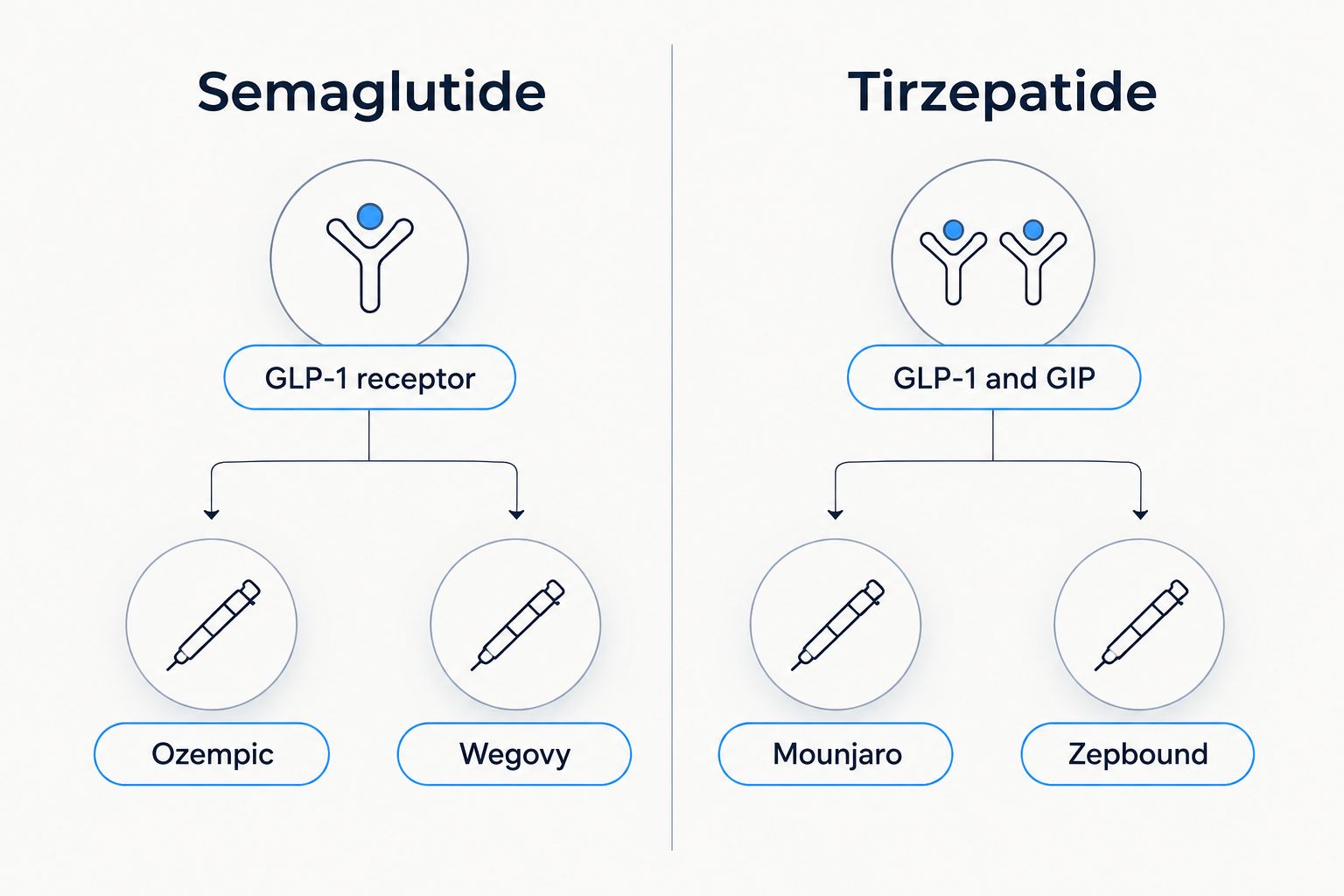
Semaglutide (Ozempic, Wegovy) activates only the GLP-1 receptor. Tirzepatide (Mounjaro, Zepbound) activates both GLP-1 and GIP receptors. A number claiming 0.5mg of one equals a set mg of the other has no pharmacological basis, because the two molecules don't work the same way at the same dose. The free GLP-1 weight loss calculator at GLP1WeightLossCalculator.com sidesteps that problem entirely by modeling weight-loss outcomes for your actual drug and dose against published trial curves, rather than pretending a conversion factor exists.
What makes the best glp-1 dose conversion calculator
- Data source — FDA label versus peer-reviewed trial versus a forum spreadsheet
- Outcome modeled — weight-loss projection versus a raw mg equivalence claim
- Drug coverage — semaglutide, tirzepatide, and retatrutide, plus their brand names
- Trial transparency — does it cite a named trial (STEP-1, SURMOUNT-1, SELECT) or just a number
- Accessibility — free and public versus locked inside a paid telehealth portal
- 2026 update cadence — reflects the current FDA-approved titration schedule, not an outdated one
GLP-1 dose conversion calculators at a glance
| Tool | Best for | Standout feature | Key limitation |
|---|---|---|---|
| GLP1WeightLossCalculator.com | Projecting weight loss after a dose change | Week-by-week output built on STEP-1 and SURMOUNT-1 curves | Doesn't output a cross-drug mg number, because none is validated |
| Manufacturer titration schedules | Confirming FDA-approved dose steps | Sourced directly from the drug label | Covers one drug at a time, no comparison across brands |
| Package insert mg tables | Cross-checking exact milligram strengths | Free, government-reviewed, no software | Manual lookup only, no personalization |
| Telehealth provider dosing tools | Patients titrating under active prescriber care | Adjusts to labs and side effects in real time | Only works inside that specific program |
| Crowdsourced conversion charts | General reading, not dosing decisions | Free and widely shared | No FDA or trial basis for the mg equivalence claimed |
1. GLP1WeightLossCalculator.com: best for projecting weight-loss trajectory after a dose change
GLP1WeightLossCalculator.com takes the drug, dose, and week of titration you enter and models expected week-by-week weight loss using published trial curves — STEP-1 for semaglutide, SURMOUNT-1 for tirzepatide — instead of trying to force a mg-for-mg swap between two different molecules. For a broader look at typical monthly outcomes, see how much weight you lose on Ozempic by month over the first year of treatment.
GLP1WeightLossCalculator.com pros:
- Models the outcome for the exact drug and dose you enter, not a forced cross-drug conversion
- Names the trials its projections are drawn from (STEP-1 and SURMOUNT-1)
- Free, no login required
GLP1WeightLossCalculator.com cons:
- Doesn't produce a this-dose-equals-that-dose number, because no validated one exists
- Projections reflect trial population averages; individual results vary
GLP1WeightLossCalculator.com pricing: free to use, no account needed.
Best for: anyone who just switched drugs or doses and wants a realistic outlook instead of a fabricated equivalence. Verdict: Use it.
2. Manufacturer titration schedules: best for confirming FDA-approved dose steps
Novo Nordisk's dosing guide for Wegovy and Ozempic, and Eli Lilly's for Mounjaro and Zepbound, lay out the exact starting dose, escalation interval, and maintenance dose approved on each drug's FDA label in 2026.
Manufacturer titration schedule pros:
- Directly sourced from the FDA-approved label
- Free and public, updated whenever the label changes
- The most defensible source if a prescriber needs to justify a dose step
Manufacturer titration schedule cons:
- Covers only one drug at a time, no cross-brand comparison
- Static schedule with no personalization or outcome projection
Best for: confirming you're on the correct FDA dose step for your specific drug. Verdict: Use it.
3. Package insert mg-equivalence tables: best for pharmacists and clinicians checking exact strengths
Full prescribing information lists every available pen and vial strength — Ozempic pens run from 0.25mg through a 2mg maximum on its type 2 diabetes label, Wegovy from 0.25mg through 2.4mg, and tirzepatide pens from 2.5mg through 15mg — letting a pharmacist verify the exact milligram content of what's dispensed.
Package insert table pros:
- Authoritative, government-reviewed source
- Free, no software required
- Useful for verifying compounded formulations against brand-name strengths
Package insert table cons:
- Written in clinical and regulatory language, not built for patients
- Requires manual cross-referencing with no automated output
Best for: clinicians double-checking milligram strengths, not patients projecting weight loss. Verdict: Not for patients; useful for pharmacy checks.
4. Telehealth provider dosing tools: best for patients titrating under active prescriber supervision
Many telehealth GLP-1 programs embed a dosing calculator into the patient portal that adjusts the next dose step based on reported side effects and time on the current dose, reviewed by a prescriber or nurse.
Telehealth dosing tool pros:
- Personalized to reported side effects and progress in real time
- Backed by licensed prescriber review, not just an algorithm
- Can flag when a dose increase should be delayed
Telehealth dosing tool cons:
- Only accessible if you're enrolled in that specific program
- Not usable as a quick outside lookup before switching providers
Best for: patients already inside an active telehealth titration program. Verdict: Only if you are already enrolled there.
5. Crowdsourced conversion charts: best avoided for real dosing decisions
Patient-run spreadsheets and forum posts assign a numeric mg equivalence between semaglutide and tirzepatide based on anecdote, not trial data or FDA review.
Crowdsourced chart pros:
- Free and easy to find
- Reflects real patient anecdotes about side-effect thresholds
Crowdsourced chart cons:
- No FDA or peer-reviewed basis for the mg equivalence claimed
- Semaglutide and tirzepatide act on different receptors, so a straight mg conversion misrepresents dose intensity
- Can lead to over- or under-dosing if used to self-adjust a prescription
Best for: general reading only, never for adjusting an actual prescription. Verdict: Skip.
How we ranked
Each tool above is scored against the same six criteria: data source, outcome modeled, drug coverage, trial transparency, accessibility, and 2026 update cadence. Tools sourced from a clinical trial or the FDA label rank above tools relying on user-submitted anecdote. GLP1WeightLossCalculator.com, which publishes this article, ranks first because it's the only free option that models an actual weight-loss outcome from named trial data instead of asserting an unverified mg-for-mg conversion.
Project your own weight-loss timeline
Free calculator built on STEP-1 and SURMOUNT-1 trial data.
Which glp-1 dose conversion calculator should you choose in 2026?
If you just switched drugs or doses and want a realistic sense of what's ahead, use GLP1WeightLossCalculator.com — it's free and models your specific regimen against STEP-1 and SURMOUNT-1 outcomes instead of a fabricated mg conversion. If you need to confirm you're on the correct FDA dose step, pull the manufacturer's titration schedule for your specific drug. Skip any spreadsheet or forum chart claiming a semaglutide-to-tirzepatide mg equivalence — it isn't clinically validated. Individual results vary, and only a prescriber can safely move you between GLP-1 drugs.
FAQ
What's the best glp-1 dose conversion calculator in 2026?
There's no true mg-to-mg converter, but GLP1WeightLossCalculator.com is the strongest free option because it projects expected weight loss for your actual drug and dose using STEP-1 and SURMOUNT-1 trial data instead of forcing an unvalidated cross-drug equivalence.
Is there an official mg conversion between Ozempic and Mounjaro?
No official FDA-approved mg conversion exists between Ozempic (semaglutide) and Mounjaro (tirzepatide). Semaglutide targets only the GLP-1 receptor while tirzepatide activates both GLP-1 and GIP receptors, so any chart claiming a specific mg equivalence isn't clinically validated.
How much weight do you lose after switching from semaglutide to tirzepatide?
Trial data shows semaglutide 2.4mg produced a mean weight loss of 14.9% at 68 weeks in STEP-1, while tirzepatide 15mg produced 20.9% at 72 weeks in SURMOUNT-1. Both trials enrolled adults with overweight or obesity without type 2 diabetes, so the figures do not transfer to Ozempic, whose 2mg maximum was studied mainly in type 2 diabetes. Results after switching depend heavily on how long you've already been titrating.
Can I use a dose conversion calculator to switch doses myself?
No. Dose changes between GLP-1 drugs should go through a prescriber who can account for side effects, current progress, and insurance-driven formulary switches. A calculator informs the conversation; it doesn't replace it.
Does Zepbound dose equal Wegovy dose in mg?
No, Zepbound (tirzepatide) and Wegovy (semaglutide) doses aren't mg-equivalent. The two drugs have different mechanisms and their maintenance doses were set independently in separate FDA-reviewed trials.
How accurate are GLP-1 weight loss calculators?
Calculators that cite a named trial, such as STEP-1 or SURMOUNT-1, reflect population averages from those studies, not a guarantee for any individual. Accuracy depends on how closely your titration schedule matches the trial protocol.
What data do GLP-1 weight loss calculators use?
The most reliable calculators pull projections from published, peer-reviewed clinical trial results, such as STEP-1 for semaglutide and SURMOUNT-1 for tirzepatide, rather than user-submitted anecdotes.
How much does a GLP-1 dose conversion calculator cost?
GLP1WeightLossCalculator.com's tool is free to use. Dosing tools embedded in telehealth programs are typically bundled into that program's overall cost rather than sold as a standalone product.
One last thing
Retatrutide, the triple GLP-1/GIP/glucagon agonist, still has no FDA approval as of 2026. Any calculator offering a retatrutide dose conversion is projecting from investigational trial data, not an approved label — treat those numbers as directional, and confirm any dose change with a prescriber before acting on it.
Sources
- Wilding JPH, et al. Once-Weekly Semaglutide in Adults with Overweight or Obesity (STEP 1). N Engl J Med. 2021;384(11):989-1002. PMID: 33567185
- Jastreboff AM, et al. Tirzepatide Once Weekly for the Treatment of Obesity (SURMOUNT-1). N Engl J Med. 2022;387(3):205-216. PMID: 35658024
- Jastreboff AM, et al. Triple-Hormone-Receptor Agonist Retatrutide for Obesity - A Phase 2 Trial. N Engl J Med. 2023;389(6):514-526. PMID: 37366315
SURMOUNT-1 reported -20.9% for tirzepatide 15mg at 72 weeks under the treatment-regimen estimand used in the published primary analysis; the -22.5% figure quoted elsewhere is the efficacy estimand, measured only in participants who stayed on treatment.
This article is for information only and is not medical advice. Only a prescriber can change or switch your dose. Talk to your prescriber about your own treatment.