
Semaglutide dosing calculators range from tools that map your dose directly onto clinical trial curves to generic BMI widgets that have nothing to do with GLP-1 pharmacology. Best overall: the GLP1 Weight Loss Calculator, because it ties week-by-week projections to STEP-1 and SURMOUNT-1 trial data. Best for the FDA-approved dose schedule itself: manufacturer titration guides from Novo Nordisk and Eli Lilly. Best budget option: generic BMI calculators, though they skip GLP-1 trial data entirely and only estimate BMI, not dose-response.
- The GLP1 Weight Loss Calculator is the best semaglutide dosing calculator for 2026 because it uses STEP-1 and SURMOUNT-1 trial curves, not flat averages.
- Manufacturer titration guides from Novo Nordisk and Eli Lilly give the exact FDA-approved dose schedule but don't project weight loss.
- Telehealth intake calculators personalize dosing to your chart but rarely publish their methodology.
- Generic BMI calculators are free and fast but ignore GLP-1 dose-response data completely.
- DIY spreadsheets built from trial PMIDs work only if you're willing to read the source papers yourself.
Why this matters
Most calculators labeled "GLP-1 weight loss" are just BMI math with a new coat of paint. That gap matters because the same drug at the same dose produces different outcomes depending on the population studied: STEP-1 (semaglutide 2.4mg, people with obesity, no cardiovascular disease requirement) averaged 14.9% body weight loss at 68 weeks, while SELECT (semaglutide 2.4mg, cardiovascular disease cohort) averaged only 9.4%.
A calculator that ignores which trial population you resemble is guessing, not projecting. The GLP1 Weight Loss Calculator builds its week-by-week output from named trial arms (STEP-1, SURMOUNT-1, SELECT) rather than a single blended average, which is the core reason it ranks first below.
What makes the best semaglutide dosing calculator
- Trial-data grounding — cites named trials (STEP-1, SURMOUNT-1, SELECT, SUSTAIN) with PMID references, not an unsourced average
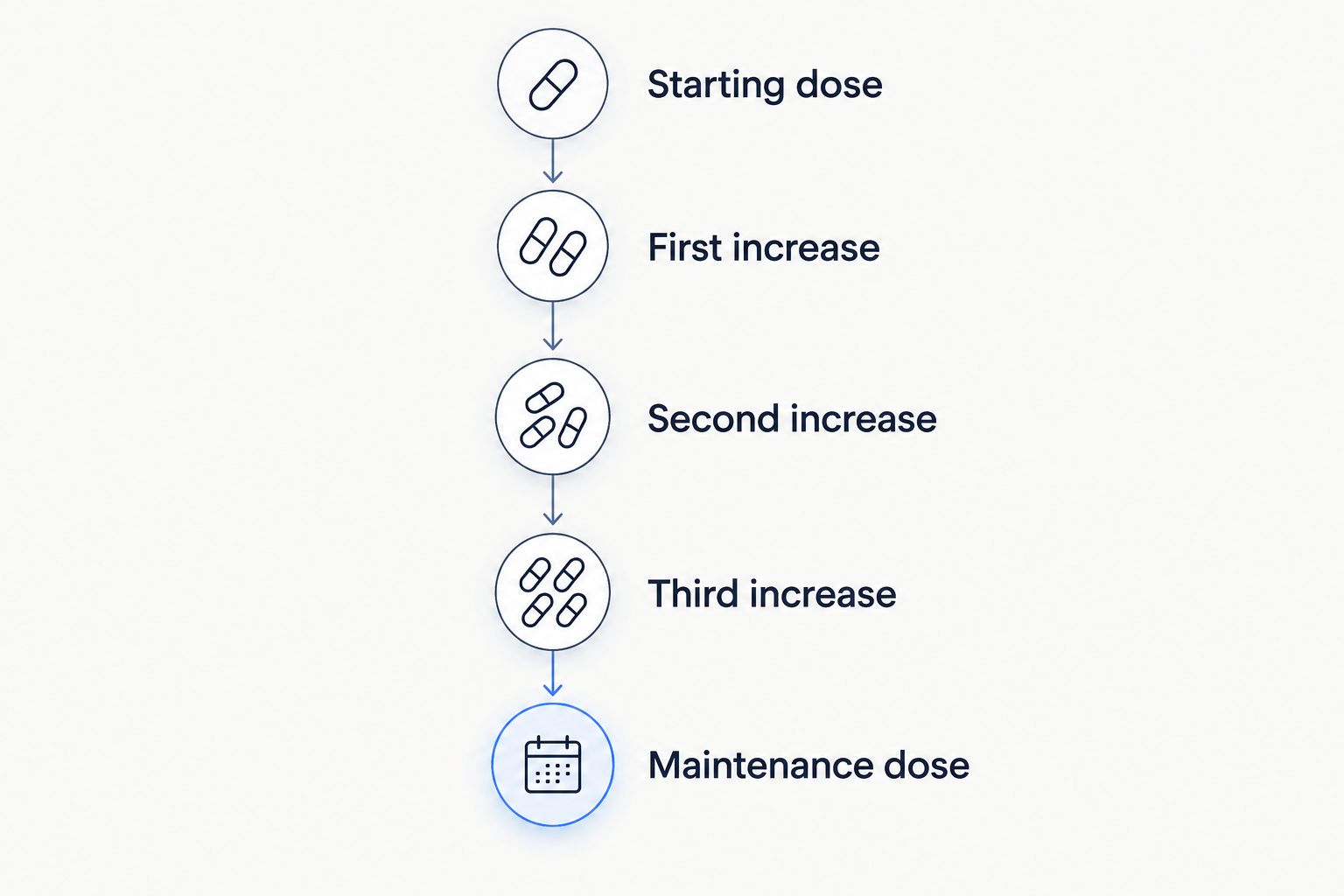
- Titration-schedule accuracy — matches the FDA-approved dose increase intervals rather than a generic ramp
- Personalization inputs — accepts starting weight, current dose, weeks on drug, and which GLP-1 you're taking
- Methodology transparency — shows the math instead of a black-box number
- Free access — no signup or telehealth intake required to see a projection
- Update cadence — reflects newer trial data, including long-term SURMOUNT-1 extensions and SELECT's 2023 results
At a glance: 2026 semaglutide dosing calculators ranked
| Calculator | Best for | Standout feature | Key limitation |
|---|---|---|---|
| GLP1 Weight Loss Calculator | Week-by-week trial-based projection | Uses STEP-1/SURMOUNT-1 dose-response curves | Projections, not guaranteed outcomes |
| Manufacturer titration guide | FDA-approved dose schedule | Official increase intervals from the drug label | No weight-loss projection at all |
| Telehealth intake calculator | Personalized clinical follow-up | Ties dosing to your actual intake chart | Methodology isn't published |
| Generic BMI/weight-loss calculator | Quick baseline math | Instant, no signup | Ignores GLP-1 trial data entirely |
| DIY spreadsheet from trial PMIDs | Full control over assumptions | You pick the exact trial arm to model | Time-consuming, requires reading papers |
1. GLP1 Weight Loss Calculator: best semaglutide dosing calculator for week-by-week trial-based projection
You enter your starting weight, which GLP-1 you're on (Ozempic, Wegovy, Mounjaro, Zepbound, or retatrutide), and your current dose. The tool maps that input onto the matching trial curve — STEP-1 for semaglutide, SURMOUNT-1 for tirzepatide — and outputs a week-by-week projection instead of a single end-of-treatment number.
GLP1 Weight Loss Calculator pros:
- Grounded in named trials with PMID citations, not an unsourced average
- Covers Ozempic, Wegovy, Mounjaro, Zepbound, and retatrutide in one tool
- Free, no account required
GLP1 Weight Loss Calculator cons:
- Projections reflect trial population averages; individual results vary
- Doesn't replace a prescriber's real-time titration decision
Best for: anyone who wants a trial-grounded weight loss projection before or during GLP-1 treatment. Verdict: Buy.
2. Manufacturer titration guide: best semaglutide dosing calculator for the FDA-approved dose schedule
Novo Nordisk's Wegovy and Ozempic prescribing information, and Eli Lilly's Zepbound and Mounjaro label, lay out the exact starting dose and the interval before each increase. This isn't a calculator in the interactive sense — it's the source document every other tool should be checked against.
Manufacturer titration guide pros:
- Directly sourced from the FDA-approved label
- Definitive on the timing of each dose increase
- Free and publicly posted
Manufacturer titration guide cons:
- Static document, no weight-loss projection
- Doesn't account for side-effect-driven dose holds your prescriber might apply
Best for: patients who need the exact escalation schedule confirmed, not a forecast of results. Verdict: Buy — as a reference, not a projection tool.
3. Telehealth intake calculator: best semaglutide dosing calculator for personalized clinical follow-up
Many telehealth prescribers run an internal calculator during intake to set your starting dose based on BMI, lab values, and reported side effects, then adjust it at each follow-up visit.
Telehealth intake calculator pros:
- Tied to an actual prescriber decision on your chart
- Adjusts in real time as you report side effects
- Bundled with scheduled follow-up visits
Telehealth intake calculator cons:
- Methodology isn't published or independently checked
- Only accessible once you're already an enrolled patient
Best for: people already enrolled with a telehealth provider who want dosing tied directly to their chart. Verdict: Hold if you're not yet a patient there.
4. Generic BMI/weight-loss percentage calculator: best for quick baseline math
Standard calculators that take your height and weight and return a BMI or a flat target percentage. They're not built for GLP-1s specifically and don't distinguish between drugs, doses, or trial data.
Generic BMI calculator pros:
- Instant, no signup, works for any weight-loss context
- Widely available, dozens of free versions online
Generic BMI calculator cons:
- Doesn't use GLP-1 trial data at all
- Can't account for which drug, dose, or titration stage you're on
Best for: a rough BMI check before you ever start a GLP-1, not for tracking dosing progress. Verdict: Skip once you're actually on a GLP-1.
5. DIY spreadsheet from trial PMIDs: best for modeling the raw data yourself
Some readers pull the published week-by-week weight-loss figures straight from the STEP-1, SURMOUNT-1, or SELECT source papers and build their own curve in a spreadsheet.
DIY spreadsheet pros:
- Full control over which trial arm and population you model
- No black box — every assumption is visible
DIY spreadsheet cons:
- Requires reading full trial papers and extracting figures by hand
- Easy to confuse an aggregate result with a per-arm subgroup number
Best for: researchers or clinicians who want to cite the primary literature directly rather than a pre-built tool. Verdict: Hold unless you already read trial papers regularly.
How we ranked these
Trial-data grounding carried the most weight, since a projection without a named trial behind it is a guess dressed up as math. Titration-schedule accuracy, personalization inputs, methodology transparency, free access, and update cadence followed in that order — the same six criteria listed above.
See your own week-by-week projection
Enter your drug, dose, and starting weight for a free trial-based estimate.
Which semaglutide dosing calculator should you choose?
For most people starting Ozempic, Wegovy, Mounjaro, or Zepbound in 2026, the GLP1 Weight Loss Calculator is the practical default because it's free and grounded in named trial data rather than a flat average. Cross-check the exact dose increase intervals against your manufacturer's titration guide, and if your prescriber's telehealth intake numbers ever conflict with either, follow your prescriber. Individual results vary, and none of these tools substitute for a conversation with your healthcare provider.
FAQ
What's the best semaglutide dosing calculator in 2026?
The GLP1 Weight Loss Calculator ranks first because it projects weight loss week by week using STEP-1 and SURMOUNT-1 trial data instead of a single blended average. Manufacturer titration guides remain the definitive source for the FDA-approved dose schedule itself.
How accurate are GLP-1 weight loss calculators?
Accuracy depends entirely on whether the calculator is grounded in named clinical trial data. STEP-1 averaged 14.9% weight loss at 68 weeks while SELECT, using the same drug and dose in a different population, averaged 9.4% — population match matters as much as the math.
Is a dosing calculator the same as a titration schedule?
No. A titration schedule sets the order and timing of dose increases as approved on the FDA label. A dosing calculator projects likely weight loss based on trial data and doesn't replace the label's escalation timeline.
Can I use a semaglutide calculator for tirzepatide (Mounjaro or Zepbound)?
Only if the calculator explicitly models tirzepatide separately using SURMOUNT-1 data, since semaglutide and tirzepatide have different dose-response curves. A calculator that treats all GLP-1s the same will misestimate results.
Do telehealth providers use different calculators than free online tools?
Yes. Telehealth intake calculators tie your starting dose to your chart and lab values but rarely publish their underlying methodology, unlike free trial-data calculators that cite specific studies.
What data do GLP-1 weight loss calculators use?
The most accurate ones cite named randomized controlled trials such as STEP-1, SURMOUNT-1, and SELECT, referencing PMID numbers so the underlying data can be checked. Generic calculators typically use BMI formulas with no GLP-1-specific data at all.
How much weight do people lose on semaglutide by month?
Weight loss on semaglutide builds gradually across the titration period, with the bulk of the STEP-1 trial's 14.9% average weight loss occurring after the maintenance dose is reached. Monthly patterns vary by starting weight and dose tolerance.
Should I trust a calculator over my doctor's dosing plan?
No. A calculator projects likely outcomes based on trial averages; your prescriber's plan accounts for your labs, side effects, and medical history, and always takes priority over any online projection.
One last thing
The SELECT trial and STEP-1 tested the identical drug and dose — semaglutide 2.4mg — yet produced a 5.5 percentage-point gap in average weight loss (9.4% versus 14.9%). The difference wasn't the calculator or the dosing schedule; it was that SELECT enrolled people with cardiovascular disease who didn't necessarily meet obesity treatment criteria. Any calculator worth using in 2026 should tell you which population its projection is modeled on, not just which drug.