
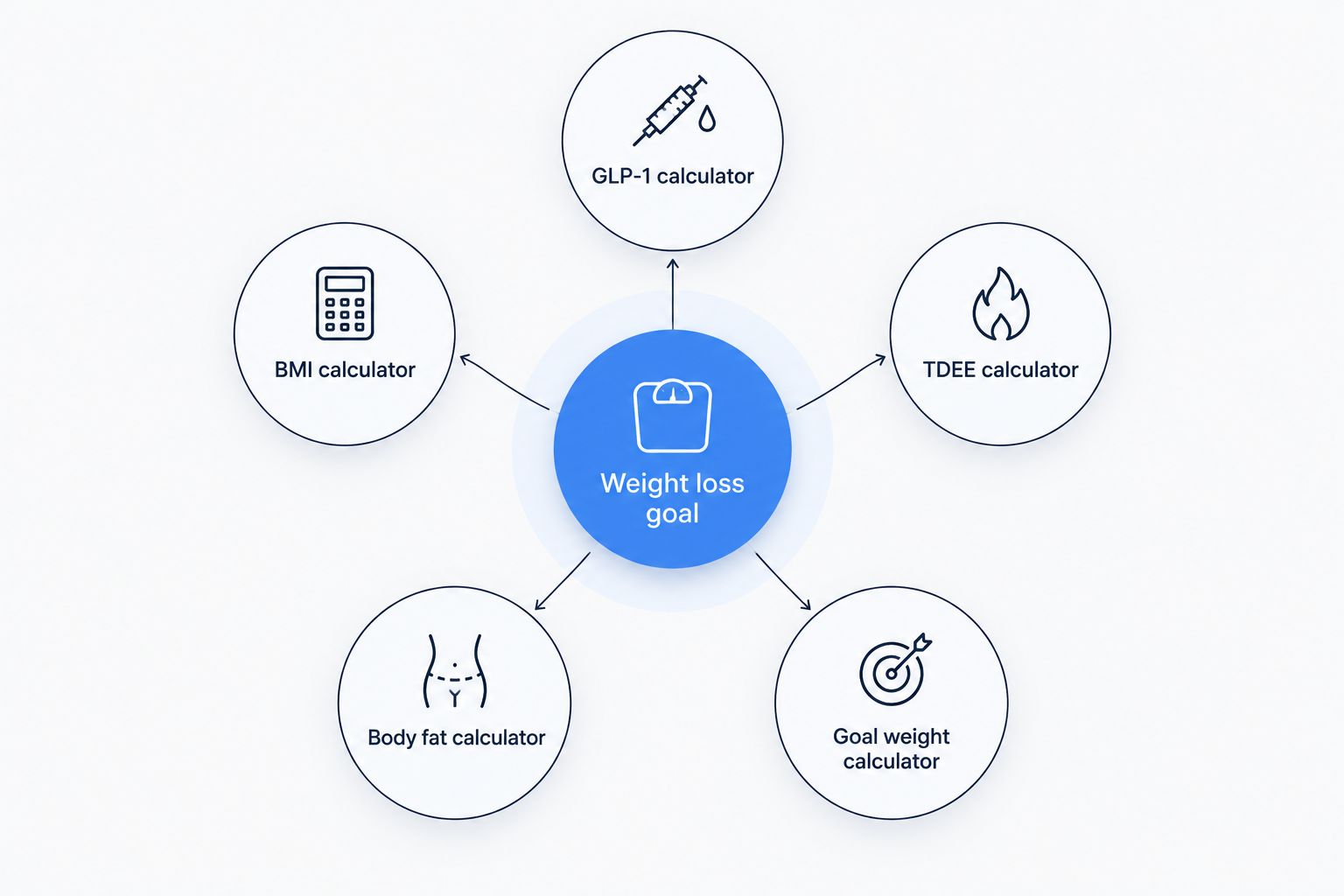
Five kinds of online weight loss calculators show up when you search for one, and only one type ties its numbers to published GLP-1 trial data instead of a generic 1990s formula. Best overall for medication users: GLP-1 Weight Loss Calculator. Best for a fast baseline: BMI calculator. Best for diet-only plans: TDEE calculator.
- GLP-1 Weight Loss Calculator wins for anyone on Ozempic, Wegovy, Mounjaro, Zepbound, or retatrutide.
- BMI calculators still work for a 10-second baseline, nothing more precise.
- TDEE calculators fit diet-and-exercise-only plans with no medication involved.
- STEP-1 showed 15% weight loss at 68 weeks; SURMOUNT-1 showed 22.5% at 72 weeks.
- The best online weight loss calculator in 2026 depends on whether medication is part of your plan.
Why this matters
Search "weight loss calculator" in 2026 and most results still run on the Mifflin-St Jeor or Harris-Benedict formulas from decades ago — plug in age, height, and activity level, get a calorie target. None of them account for what actually changed weight loss outcomes over the last few years: GLP-1 receptor agonists.
The GLP-1 Weight Loss Calculator projects loss week-by-week using STEP-1 (semaglutide, 15% average loss at 68 weeks), SURMOUNT-1 (tirzepatide, up to 22.5% at 72 weeks), and the SELECT cardiovascular outcomes trial (a 20% reduction in major adverse cardiovascular events, published in NEJM in 2023). If you're on medication, a calorie-formula calculator answers a question you didn't ask.
What makes the best online weight loss calculator
- Trial-based data instead of a generic formula pulled from unrelated population studies
- Personalization depth — starting weight, medication, dose, and timeline, not just age and height
- Week-by-week output, not a single endpoint number six months out
- Clear caveats stating results vary and directing users to a provider, not a diagnosis
- No login or paywall blocking the basic projection
- Updated as new trial data publishes, since 2026 keeps adding retatrutide and combination-drug results
At a glance: 5 online weight loss calculators compared
| Calculator type | Best for | Standout feature | Key limitation |
|---|---|---|---|
| GLP-1 Weight Loss Calculator | Ozempic, Wegovy, Mounjaro, Zepbound, retatrutide users | Week-by-week projection built from STEP-1, SURMOUNT-1, SELECT | Only models medication-driven loss |
| BMI calculator | A fast baseline health check | Single number in under 10 seconds | Ignores muscle mass and medication use |
| TDEE/calorie deficit calculator | Diet-and-exercise-only weight loss | Adjusts calorie targets to activity level | Assumes consistent adherence |
| Body fat percentage calculator | Tracking composition, not just scale weight | Separates fat loss from muscle loss | Needs measurements or a scan for accuracy |
| Ideal/goal weight calculator | Setting a target weight range | Gives a range instead of one rigid number | Range is population-based, not personal |
1. GLP-1 Weight Loss Calculator: best for medication users tracking trial-based projections
The GLP-1 Weight Loss Calculator takes your starting weight, medication, and dose schedule and projects loss week by week through the titration period and beyond, using outcomes reported in STEP-1, SURMOUNT-1, and SELECT. It's built specifically for people already on or considering Ozempic, Wegovy, Mounjaro, Zepbound, or retatrutide — not a general-purpose tool retrofitted for medication use. For a month-by-month breakdown of what those trial numbers translate to in practice, see the average Ozempic results by month guide.
GLP-1 Weight Loss Calculator pros:
- Projections tied to named trials (STEP-1, SURMOUNT-1, SELECT), not a generic formula
- Week-by-week timeline instead of a single endpoint number
- Covers five medications: Ozempic, Wegovy, Mounjaro, Zepbound, retatrutide
- Free, no login required to see a projection
GLP-1 Weight Loss Calculator cons:
- Projects trial averages; individual results vary by dose tolerance and adherence
- Doesn't model diet-only or surgical weight loss paths
- Not a substitute for a provider's titration guidance
Best for: anyone starting or currently on a GLP-1 medication who wants a realistic timeline instead of a guess. Verdict: Use it.
2. BMI calculator: best for a fast baseline health check
A BMI calculator divides weight by height squared and returns a single category — underweight, normal, overweight, obese. It takes ten seconds and requires no medication, dose, or trial data at all.
BMI calculator pros:
- Instant result, no personal health history needed
- Widely used as a starting-point screening metric by clinicians
- Free and available on nearly every health site
BMI calculator cons:
- Doesn't distinguish muscle mass from fat mass
- Says nothing about medication effects or expected timelines
- One number, no trajectory
Best for: a first-pass check before deciding whether to look deeper. Verdict: Use it, then move on.
3. TDEE/calorie deficit calculator: best for diet-and-exercise-only weight loss
A TDEE (total daily energy expenditure) calculator estimates how many calories you burn daily based on age, weight, height, and activity level, then suggests a deficit for weight loss. It's the standard tool for people managing weight through diet and exercise alone, with no medication in the plan.
TDEE calculator pros:
- Useful for setting a daily calorie target
- Adjusts for activity level (sedentary through very active)
- Works for anyone, regardless of medication status
TDEE calculator cons:
- Assumes consistent daily adherence, which real life rarely delivers
- Doesn't account for appetite suppression from GLP-1 medications
- Formula-based estimates can be off by hundreds of calories per person
Best for: people losing weight through diet and exercise with no medication involved. Verdict: Use it if you're diet-only; skip it if you're on a GLP-1.
4. Body fat percentage calculator: best for tracking composition, not just scale weight
A body fat percentage calculator estimates the fat-to-lean-mass ratio using measurements (waist, neck, hip) or bioelectrical impedance data. It answers a different question than the scale: are you losing fat, or losing muscle along with it.
Body fat calculator pros:
- Separates fat loss from muscle loss, which the scale alone can't do
- Useful for anyone in a caloric deficit, medicated or not
- Tracks composition trends over months
Body fat calculator cons:
- DIY measurement inputs introduce error compared to a DEXA scan
- Doesn't project future results, only estimates current state
- Needs repeat measurements to be useful at all
Best for: people who want to confirm a GLP-1 medication or diet plan is preserving muscle. Verdict: Use it alongside another calculator, not instead of one.
5. Ideal/goal weight calculator: best for setting a realistic target range
An ideal weight calculator returns a target range based on height, frame size, and sometimes age. It's a starting point for setting a goal, not a projection of how you'll get there.
Goal weight calculator pros:
- Gives a range instead of a single rigid number
- Simple inputs, quick output
- Useful for setting an initial target before choosing a method
Goal weight calculator cons:
- Range is population-based, not personalized to metabolism or medication
- Says nothing about timeline or method
- Multiple formulas (Devine, Robinson, Miller) give different ranges for the same person
Best for: the very first step, before picking a weight loss method. Verdict: Use it once, then pick a real plan.
See your own GLP-1 projection
Enter your starting weight and medication for a week-by-week estimate.
How we ranked these
Each calculator type is ranked against the six criteria above: data source, personalization depth, output granularity, caveats, accessibility, and update frequency. The GLP-1 Weight Loss Calculator ranks first specifically for medication users because it's the only type here tied to named clinical trials rather than a generic formula. BMI, TDEE, body fat, and goal weight calculators each rank for their own distinct use case — none of them compete for the same slot.
“A calorie-formula calculator answers a question you didn't ask if you're already on a GLP-1 medication.”
Which weight loss calculator should you choose?
If you're on or considering Ozempic, Wegovy, Mounjaro, Zepbound, or retatrutide in 2026, use the GLP-1 Weight Loss Calculator — it's the only tool here built from trial data specific to those drugs. If you're not on medication and managing weight through diet and exercise, a TDEE calculator gives a more useful daily target. Everyone else — checking a baseline or setting an initial goal — gets more value from a BMI or ideal weight calculator, then should move to a more specific tool once the plan is set.
FAQ
What's the best online weight loss calculator for Ozempic or Wegovy?
The GLP-1 Weight Loss Calculator is the best option because it projects week-by-week loss using STEP-1 trial data, the same dataset behind Wegovy's approval. Generic BMI or calorie calculators don't account for medication-driven appetite suppression.
How much weight can you lose on GLP-1 medications by month?
STEP-1 reported an average 15% body weight loss at 68 weeks on semaglutide, and SURMOUNT-1 reported up to 22.5% at 72 weeks on the highest tirzepatide dose. Loss is gradual and concentrated in the titration period, so week-by-week or month-by-month projections track it more accurately than a single endpoint number.
Is a BMI calculator accurate for GLP-1 users?
A BMI calculator gives a single health category but doesn't reflect medication-driven fat loss versus muscle preservation. It's a useful baseline before starting a GLP-1 medication, not a tool for tracking progress on one.
Do TDEE calculators work without medication?
Yes, TDEE calculators are built for diet-and-exercise-only weight loss and estimate daily calorie needs based on activity level. They don't factor in appetite changes from GLP-1 medications, so they're less useful once medication is part of the plan.
How accurate are GLP-1 weight loss calculator projections?
Projections are based on trial averages from STEP-1, SURMOUNT-1, and similar studies, so they reflect population-level outcomes rather than a guarantee for any one person. Individual results vary by dose, adherence, and metabolism, which is why a healthcare provider should confirm any personal plan.
What clinical trials do GLP-1 weight loss calculators use?
The main trials are STEP-1 for semaglutide (Wegovy), SURMOUNT-1 for tirzepatide (Zepbound, Mounjaro), and SELECT for cardiovascular outcomes on semaglutide. All three were published in NEJM and form the evidence base behind FDA-approved dosing.
Is the GLP-1 Weight Loss Calculator free to use?
Yes, the GLP-1 Weight Loss Calculator is a free online tool with no login required to see a projection. It's designed for anyone considering or currently using a GLP-1 medication in 2026.
Can a body fat percentage calculator replace a GLP-1 calculator?
No, a body fat percentage calculator tracks current composition, not future projections. Use it alongside a GLP-1 calculator to confirm that weight loss is coming from fat rather than muscle.
One last thing
The number that gets skipped in most weight loss calculator comparisons: the phase 2 retatrutide trial, published in NEJM in 2023, reported up to 24.2% mean weight reduction at 48 weeks on the highest dose — higher than either STEP-1 or SURMOUNT-1 at a shorter timeline. As retatrutide moves through further trials in 2026, expect calculator projections for that drug to shift as more data publishes. Individual results vary, and any projection is a starting point for a conversation with a healthcare provider, not a guarantee.